
Factors influencing post-use ESL authorial confidence for new authorial voice learning technology
a University of Otago jasksing@gmail.com
b University of Northern British Columbia Canada, Prince George, Canada
c University of Waikato, School of Education, New Zealand
Corresponding author: jasksing@gmail.com
DOI: https://doi.org/10.5281/zenodo.15635738
Abstract
This exploratory study reports the factors that led to post-use changes in authorial confidence for students who used a newly-developed authorial voice learning technology. The AVATAR prototype is a student-facing academic writing learning technology designed to help first-year university students become aware of and reflect on their authorial voice in English argumentative essays. 23 first-year Fijian university students who used English as a Second language (ESL) trialed AVATAR using an authentic argumentative essay assignment. Pre- and post-use authorial confidence data was captured via questionnaires and interviews. Key findings showed a statistically significant difference between pre- and post-use authorial confidence. Deductive thematic analyses of interview responses AVATAR’s affordances for visualizing authorial voice in the participants’ written texts and a cycle of self-reflection on and editing for authorial voice. The findings have implications for authorial voice pedagogical support and the design and development of academic writing technologies.
1 Authorial confidence in English academic writing in ESL contexts
1.1 Introduction
Developing authorial confidence is important because effective academic writing is not merely about conveying information but also about projecting a strong authorial voice (Hyland, 2002). A strong authorial voice involves showing confidence and commitment to one's ideas, mostly by using assertive language and self-references (Hyland, 2002; Lehman & Sułkowski, 2020). In the context of academic writing, the skillful use of one's authorial voice affects how students represent themselves and interact with readers (Castelló & Iñesta, 2012). Developing students' awareness and skill with their authorial voice has been consistently shown to improve their writing performance (Castelló & Iñesta, 2012; Khalsa, 2015; Yang et al., 2019). This rhetorical skill is particularly important in the argumentative essay as it is the most common genre of assignment writing at university (Stapleton, 2017) and the language used in this type of essay tends to tends to be culturally loaded (Kirkpatrick, 2017; Stapleton, 2017), making argumentative essay writing prone to challenges for English as a Second Language (ESL) students. Moreover, first-year university students benefit greatly from explicit authorial voice instruction as it can clarify rhetorical conventions (Gennrich & Dison, 2018), help make their writing stronger (Geng & Wharton, 2016; Lee & Deakin, 2016), and instill a sense of ownership and agency within their academic writing (Nsanja, 2018; Viete & Le Ha, 2007). Pedagogical research and development focusing on academic writing has generally operationalized authorial voice using two interrelated aspects (Stock & Eik-Nes, 2016): performance aspects, which deal with the knowledge, skillful deployment, and effects of language, and authorship beliefs, which can incorporate self-perception beliefs such as authorial identity and authorship beliefs, including confidence. Notably, while the performance of a strong authorial voice by using appropriate language is crucial for successful academic writing, the development of authorship beliefs such as authorial confidence is equally important because these beliefs impact the development of authorial voice and writing performance (Lehman & Sułkowski, 2020). This study focuses on a specific authorship belief termed authorial confidence.
Authorial confidence refers to the degree to which students feel they can express their own voice, authority, and commitment to their ideas within their written work. This study treats authorial confidence as an authorship belief that is synonymous with constructs such as self-efficacy because self-efficacy in writing deals with the development of an authorial identity (Maguire et al., 2013). Authorial confidence, as an aspect of authorial voice, is a crucial aspect of academic writing for novice university students who speak ESL because first-year university students' authorial confidence impacts their academic achievement (Chesser-Smyth & Long, 2013). These challenges are often rooted in performance-related issues such as a lack of proficiency, preparedness (Finn, 2018; Khalsa, 2015), and practical experience with employing linguistic features that articulate the student's stance or effectively engage readers (Ellery, 2008; MacIntyre, 2019). When new ESL university students have low esteem of themselves as writers, it can lead to poor quality of written work (Maguire et al., 2013; Prat-Sala & Redford, 2012). While ESL students bring unique perspectives and experiences to academic discourse (Rahnuma, 2023; Zhu, 2022), these students can also encounter barriers that impact their confidence in articulating their thoughts and ideas in English (Rahnuma, 2023; Zhu, 2022). Novice ESL students can be more reliant on source texts in their writing (Zhang & Wang, 2023) and may not express overt commitment to their claims, which are indications of weak authorship beliefs (Fangzhi, 2020). Even more, students who write essays that sound confident may actually not have high authorial confidence because there is a potential for discrepancies between the apparent confidence in student writing and their actual self-perceived confidence as writers (Broda et al., 2020).
These challenges then further impact ESL students' authorship beliefs, leading to low authorial confidence and self-efficacy beliefs (Ellery, 2008; Lehman & Sułkowski, 2020). ESL students often grapple with feelings of insecurity stemming from the abovementioned linguistic challenges and the potential divergence of their cultural norms from the academic conventions of English writing (Hyland, 2012). The development of pedagogical affordances for authorial voice that focus on building authorial confidence are thus crucial for university students as they play a pivotal role in helping students engage with their academic writing and project their authorial voice within academic writing (Lee & Deakin, 2016). Studies that investigated challenges (Khalsa, 2015; Prat-Sala & Redford, 2012) or developed learning tools (Chen & Zhang, 2019; Fernández & Escobar, 2018; Mohammed, 2019) for authorial voice in ESL students' argumentative essays emphasize the importance of addressing students' confidence in their role as writers. In the ESL educational context of Fiji, aside from language proficiency challenges such as grammatical errors and limited awareness and skill with rhetorical strategies (Chand, 2014; Goundar & Bogitini, 2019), students coming to university are often underprepared in terms of adapting to the critical thinking required in university-level argumentation (Sameer, 2014) and balancing one's authorial voice with other sources (Al Badi, 2015; Giridharan, 2012; Goundar, 2019). These issues often lead to and are compounded by low levels of writing confidence amongst first-year ESL students in Fiji (Sameer, 2014). However, there is a lack of research for supporting authorial confidence development in the higher education contexts of small Pacific Island nations such as Fiji.
1.2 Fiji ESL context and authorial confidence
Fiji is a small nation in the Pacific Islands with a diverse and multicultural population. The heavy influence of the English language in Fiji comes from its history as a former British colony, with the English language gradually emerging as a predominant system of communication in education, commerce, entertainment, and politics. The Fijian population consists mainly of native I-Taukei and Fijians of Indian ancestry alongside other Pacific Islanders, individuals of Chinese or European heritage, each with their own array of native languages. This has resulted in an informal variety of English being used as a de facto lingua franca. It is noteworthy, however, that merely 1% of Fiji's population has English as their native tongue (Tent, 2004). For most of the population, English functions as an additional language (Chand, 2014). However, English serves as the medium of instruction at both primary and secondary educational levels (Chand, 2014). Despite their exposure to the English language, Fiji educators and researchers often underscore the poor academic writing performance of Fiji tertiary-level students (Chand, 2014). University students in Fiji often struggle with English academic writing, leading to issues of low confidence and motivation (Sameer, 2014).
In this context, the cultural background of the various Fijian ethnic groups have been of interest for pedagogical research regarding literacy in Fiji (Goundar, 2023). Dakuidreketi (2014) points to a misalignment between the beliefs and practices of students' traditional ways of knowing and assessment methods. For example, that traditions of oral cultural practices of I-Taukei students have an influence on academic achievement when compared to the more literacy-aligned culture of other races in Fiji. The approaches to education (Dakuidreketi, 2014) alongside practices of educational institutions (Tokalauvere, 2008) have also been described as influencing the differences in performance levels amongst I-Taukei and other Fijian students. However, Sameer's (2014) study of university students enrolled in an English for Academic Purposes (EAP) course found no major differences in the academic writing needs of students along cultural lines. This points to a need to further clarify the factors that impact Fiji students' academic writing. Moreover, Hopf (2019) points to a lack of locally developed literacy tools in the Fiji ESL context. In fact, there is a dearth of studies that investigate the factors which affect usage and user experiences of Fijian students using academic writing educational technologies. There are also no studies that focus on the interplay between writing confidence levels of Fiji ESL university students and their use of academic writing learning technologies. This lack of affordances for authorship beliefs is reflective of the general trend in the design and development of academic writing education technologies.
1.3 Affordances for authorial confidence in learning technologies
Academic writing educational technologies that focus on providing support for argumentative essay writing utilize corpus analyses of student writing as a foundation for their pedagogical affordances. These technologies can be broadly classified as automated evaluation systems (AES), intelligent tutoring systems (ITS), and interactive writing platforms (IWP; Hasan et al., 2020). These systems differ in the types of educational support they offer to the student as a writer. Automated essay scoring or evaluation systems are usually used to analyze student essays based on established criteria to highlight language achievements and issues in the essays. ITS and IWPs are more recent tools that go beyond the automated corpus analyses and incorporate strategic guidance in their affordances, such as creating awareness and offering advice on rhetorical moves. These tools attempt to develop students' writing skills using interaction with technology as a means to enhance language development (Chapelle, 2003). They mainly provide affordances for the performance aspects of authorial voice in academic writing, i.e., the skillful use of language in the students' writing to make their essays acceptable to their academic community. This could be because the automated corpus analyses of texts and associated learning analytics are conducive underpinnings for the development of technology-based tools, even more so for pedagogical approaches that prioritize assessment and feedback. Thus, the pedagogical focus of most writing support software tends to be on micro-level skills such as grammar and word choices (Strobl et al., 2018).
However, there is a lack of an integration of affordances for authorship beliefs, such as reflection on authorial confidence, in these academic writing technologies. Although ITS and IWPs attempt to address student sentiment (Knight et al., 2020), academic writing learning technologies still tend to focus mostly on the performance aspects of academic writing and do not usually put students' self-perception of themselves as writers as a central affordance. However, it is important that the development of academic writing technologies consider students' authorial confidence since it not only impacts how students feel about themselves as writers but their motivation and engagement with their academic writing (Lehman & Sułkowski, 2020). Incorporating affordances for self-awareness addresses extra-textual aspects (Tardy, 2012; Zhao, 2019) of authorial voice development. Studies of ESL university students' argumentative essay writing that utilized self-reflection as a strategy to develop authorial voice strength have reported post-treatment increases in academic writing confidence (Fernández & Escobar, 2018; Fogal, 2015; Khalsa, 2015).
Meanwhile, although studies of academic writing learning technologies have reported post-use increases in authorial confidence (Davis & Morley, 2022; Mohammed, 2019), the learning technologies tested in these studies focus on the awareness and acquisition of linguistic performance skills. They usually tested change in authorial confidence as an effect rather than providing explicit affordances for it in the learning technology's system. It is important to explore the impact that in-built affordances for student reflection may on authorial confidence because ESL university students' low authorial confidence has detrimental effects on their writing and their use of learning technologies (Zhang, 2019). Despite the fear of generative technologies replacing student input and creativity, academic writing educational technologies have the potential to serve as significant tools for student empowerment (Johnson, 2007) and help writers to not just construct arguments but also themselves (Lea & Jones, 2011). However, it is important in educational design to test the real-world factors that can inform the improved development of educational technologies (Van den Akker et al., 2006). This paper thus explores the factors that impacted ESL Fiji university students' authorial confidence upon their use of a new authorial voice learning technology.
2 AVATAR, a new authorial voice learning tool
2.1 Theoretical frameworks and functionality
Authorial Voice Toolkit for Authorship Reflection (AVATAR) is a newly-developed intelligent tutoring system designed to foster the awareness and development of authorial voice in ESL university students writing argumentative essays. Its design is based on a constructivist theory of action (Taber, 2017) as AVATAR operates on the notion that given opportunities to explore and experiment with their authorial voice, students would be able to create stronger authorship beliefs. To this end, AVATAR simplifies authorial voice and operationalizes it as comprising of two major aspects: performance and authorship beliefs. Figure 1 shows how AVATAR incorporates affordances for these two aspects.
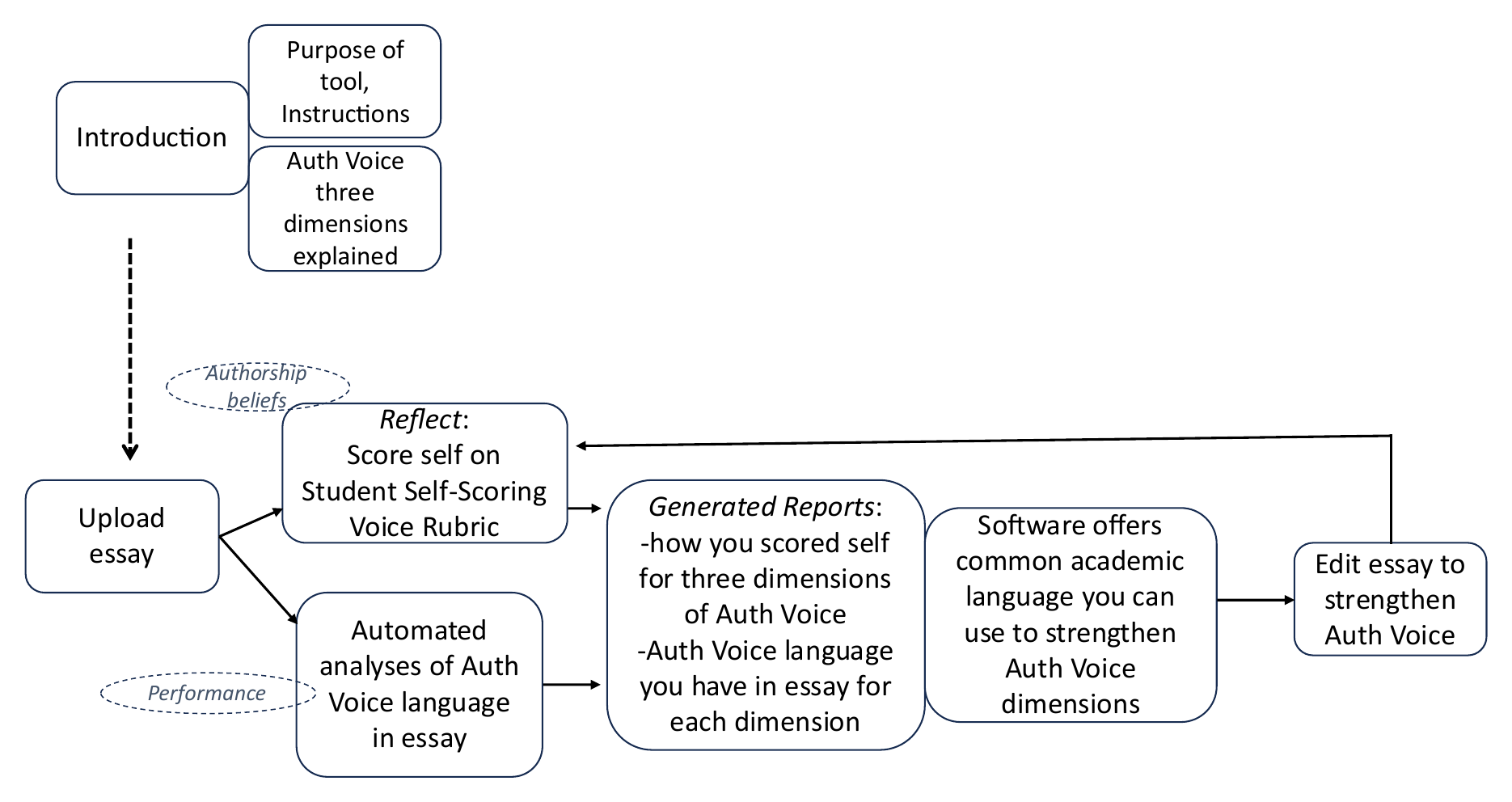
The textual component of AVATAR addresses the performance aspects of authorial voice, i.e., the linguistic expressions from Hyland's (2005) model of stance and engagement. These are words/phrases that can be used by writers to: 1. express their stance using hedges, boosters, attitude markers and self-mentions and 2. engage their readers using reader references, directives, questions, shared knowledge, or personal asides (Hyland, 2005). In doing so, AVATAR follows Zhao's (2013) operationalization of authorial voice in argumentative essays wherein the above-mentioned linguistic functions are associated with three broad dimensions of authorial voice:
Dimension 1: Presence and clarity of ideas = central points, directives
Dimension 2: Manner of idea presentations = hedges, boosters, attitude markers
Dimension 3: Writer and reader presence = self-mentions, reader references.
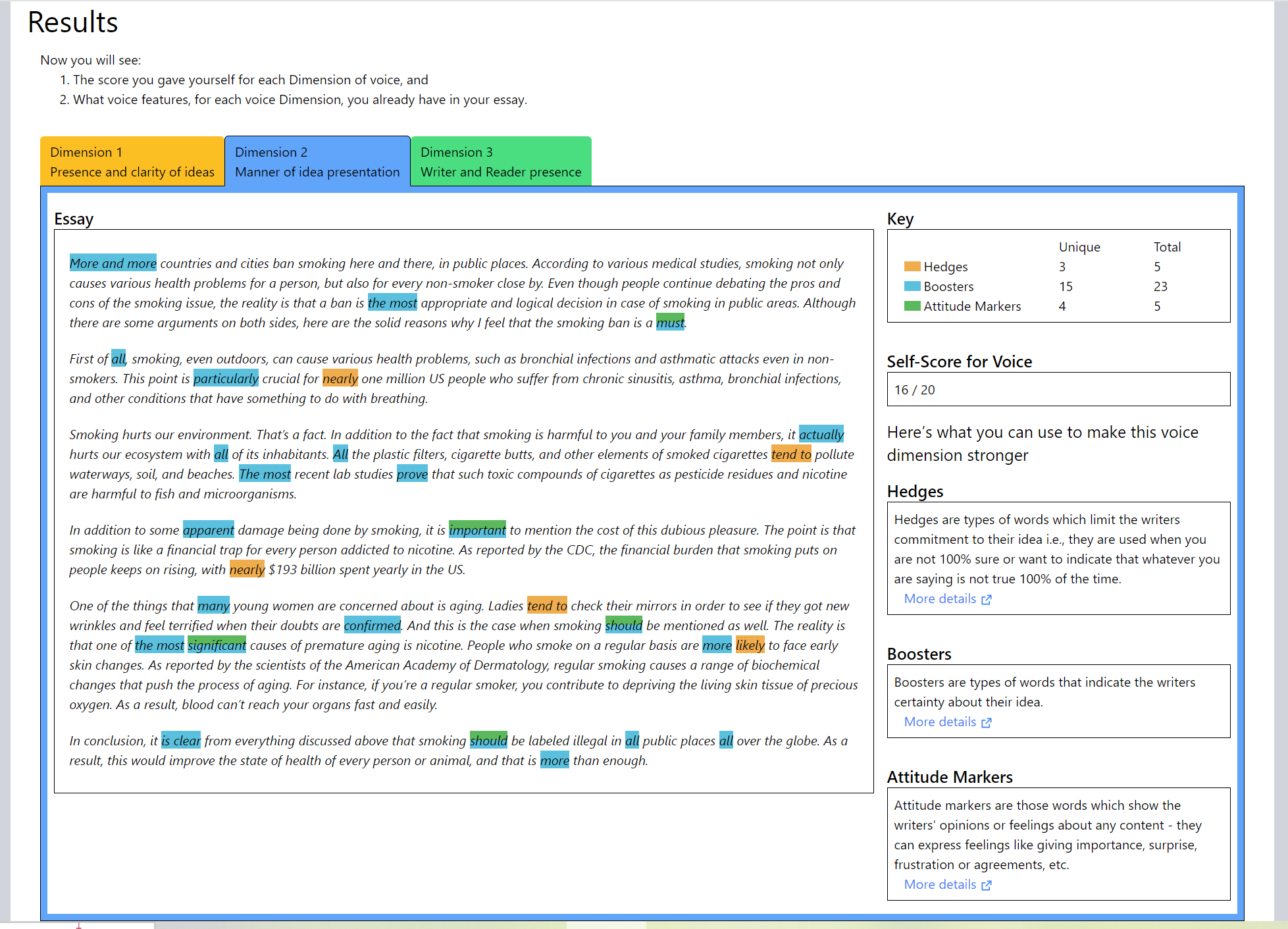
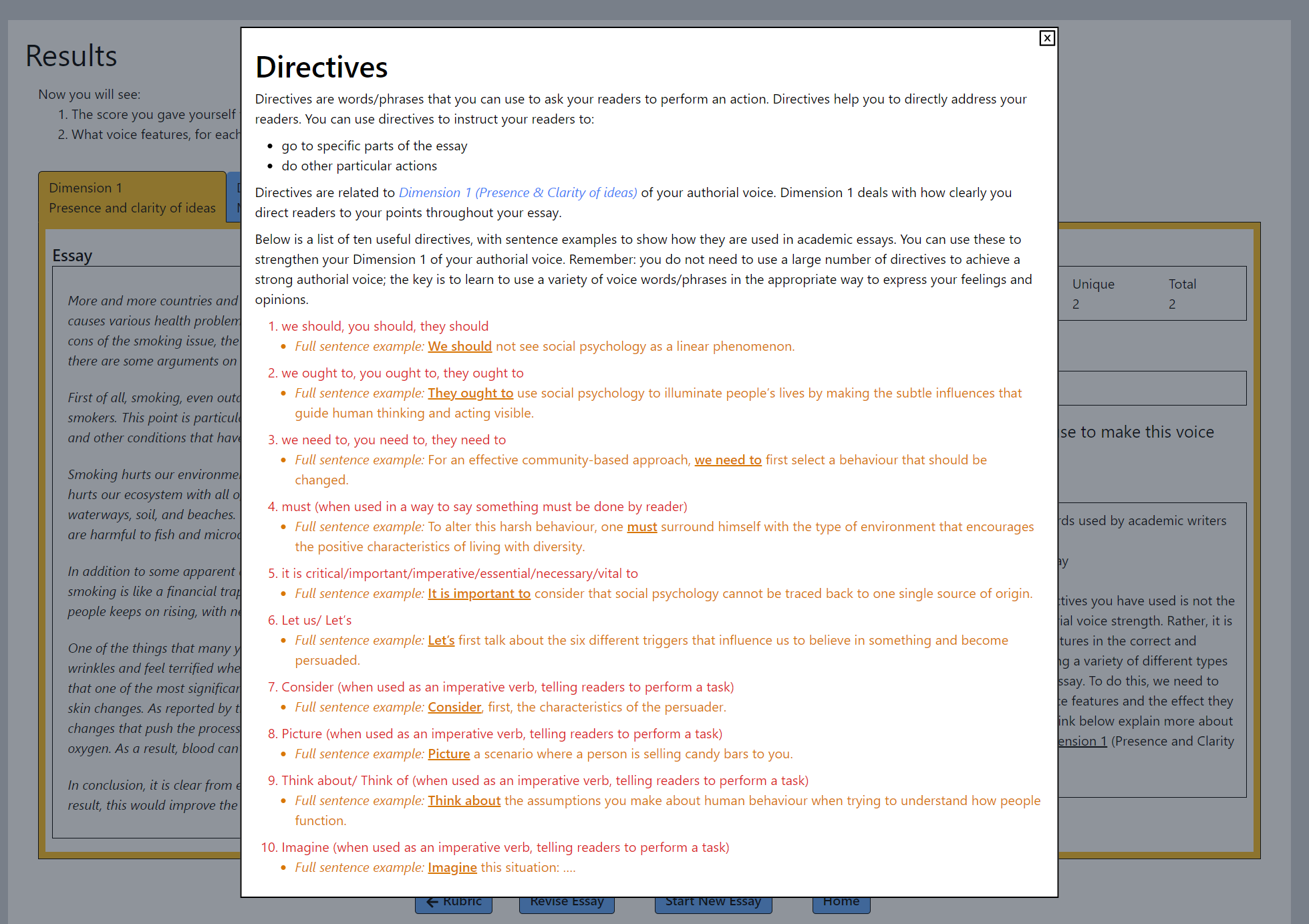
Developing ESL students' knowledge and skillful use of these linguistic expressions has been shown to strengthen their authorial voice and lead to higher quality argumentative essay writing (Dastjerdi & Shirzad, 2010; Fernández & Escobar, 2018; Fife, 2018; Fogal, 2015; Khalsa, 2015; Mazdayasna & Zaini, 2015). AVATAR introduces the user to these linguistic functions, creates awareness by highlighting them in uploaded essays (Figure 2), and encourages their use by offering exemplars (Figure 3).
Moreover, AVATAR distinguishes itself from other academic writing technologies by also providing explicit affordances for the authorship belief aspects of authorial voice. This is done through asking students to reflect on their authorial voice using a student-facing voice rubric. This self-scoring voice rubric is adapted from Zhao's (2013) voice analytic rubric. AVATAR thus operates on the rationale that self-assessment serves as an effective strategy for helping students to critically reflect on their writing practices (Chung et al., 2021; Nielsen, 2014). The self-scoring voice rubric follows Zhao's (2013) voice rubric in having three dimensions of authorial voice with each dimension associated with specific authorial voice linguistic expressions.
When a student submits their essays to AVATAR, the system prompts them to assess the strength of their authorial voice, stimulating self-awareness of authorial voice. Simultaneously, AVATAR performs an automated corpus analyses of students' uploaded essay to detect the authorial voice linguistic expressions already present in the essay. This corpus analyses follows Yoon (2017) method of using regular expressions to detect authorial voice linguistic expressions typically found in argumentative essays, i.e., directives, hedges, boosters, attitude markers, reader pronouns, and self-mentions (Yoon, 2017; Yoon & Abdi Tabari, 2023; Yoon & Römer, 2020). AVATAR then provides a personalized report (Figure 2) to the student which visualizes their authorship beliefs (i.e., how the student self-scored their essay for authorial voice) and their performance (i.e., the authorial voice linguistic expressions the student already used to express the three dimensions of their authorial voice). Additionally, AVATAR provides students with suggestions for enhancing each dimension of authorial voice (Figure 3). If a student has given themselves a low self-score for a dimension of authorial voice, they can edit their essay using the examples provided by AVATAR. They are then free to reflect on their authorial voice again. This cyclical process (Figure 1) captures AVATAR's affordances and approach to promoting authorial voice awareness and development among students writing argumentative essays.
3 User experience test
3.1 Research approach and aim
Building on a previous paper that establishes statistically significant post-use changes in participants' authorial confidence (Singh et al., 2023), this study further explicates the findings of a one-group pre-post-test user experience test by describing the factors that influenced the post-use change in the authorial confidence of 23 Fiji first-year ESL undergraduate students after a short usage session (40-45 min.) with the AVATAR prototype software. The one-group pre-post-test research design was considered appropriate for this study as it established temporal precedence (Salkind, 2010, p. 1172), while concerns about history and maturation were addressed by conducting the post-test measure immediately after the participants used AVATAR. This design was in service of the following research question:
RQ: What contextual factors influenced post-use changes in the authorial confidence of students using AVATAR?
3.2 Participants
Participants were sought from an EAP course during Semester 1, 2022, at a prominent public university in Fiji. All selected participants were first-year undergraduates who used English as a second or third language and had successfully completed Fiji Year 13 English as part of their final secondary school examination, wherein English was the language of instruction. Participants' ages ranged from 18 to 20, with a mean age of 19 and a standard deviation of 0.71. Although efforts were made to achieve gender and ethnic balance, the use of convenience sampling made it difficult to ensure a balanced demographic representation. Ultimately, the sample consisted of students from the two major ethnic groups in Fiji: 12 students who identified as I-Taukei (6 female, 6 male) and 11 who identified as being of Fiji-Indian (6 female, 5 male). The I-Taukei students spoke dialects of the indigenous I-Taukei language as their mother tongue. Social-historical factors have led to a particular dialect of the indigenous I-Taukei language becoming dominant. For the participants of Indian descent, Fiji Hindi (a unique variety of Hindi resulting from mixing and simplification of various languages of Indian origin) was the mother tongue. All participants spoke Fiji English, an informal variety of English that has borrowed from local languages and is used as a lingua franca. Overall, the participants were multilingual with years of exposure and instruction in the English language.
3.3 Instrument
The primary research tool employed in this investigation is a subset of the Student Attitudes and Beliefs About Authorship Scale aka SABAS (Cheung et al., 2017). Comprising of 17 Likert scale statements in English about authorship, SABAS offers a spectrum from 1 (strongly disagree) to 6 (strongly agree). As SABAS is constructed in simple language meant for student use, this study used the original SABAS questionnaire. The SABAS questionnaire and the three sub-scales within it have been psychometrically validated (Cheung et al., 2017). SABAS and its internal sub-scales have also been directly used as post-intervention measures of university students' attitudes and beliefs about online learning (Simonovic et al., 2022), investigations of ESL university student-writers' authorial identity beliefs (Amanollahzadeh et al., 2024; Elander et al., 2017), and exploring first-year university students' self-beliefs about their authorial identity (Walsh, 2018). The specific sub-scale for this study assesses ‘authorial confidence’ and comprises eight out of the seventeen statements contained within SABAS (i.e., items 1, 3, 4, 9, 11, 12, 13, 14). Each participant's pre-use and post-use authorial confidence was calculated by computing the mean for the eight survey items for authorial confidence (Cheung et al., 2017). A digital voice recorder was also used to record and transcribe pre- and post-use interviews.
3.4 Data Collection
Following ethical approval, data collection was done in one-on-one sessions. The pre-use session consisted of participants partaking in a semi-structured interview and answering the SABAS questionnaire. Following this, participants used an authentic argumentative essay assignment from their EAP course with AVATAR. A laptop and login details were provided and participants were free to use AVATAR for as long as they wanted and to ask for clarifications. Once the participant indicated they were finished using the system, they were asked to fill in a post-use SABAS questionnaire, followed by partaking in a post-use interview. Both pre- and post-use interviews featured questions about the participants confidence as writers, their awareness of and experience with their authorial voice, and their reasons for any post-use changes in their authorial confidence. The interviews were semi-structured, lasted 35-40 min., and aimed to identify the factors that contributed to post-use authorial confidence changes.
3.5 Data Analyses
For the quantitative data, the total pre- and post-use authorial confidence levels for each participant (N=23) was recorded. As the dataset was not normally distributed, a Wilcoxon Signed Ranks test was performed to test for change in authorial confidence and the effect size was calculated.
In terms of qualitative data analyses, participants' pre- and post-use responses to the interview questions about their authorial confidence were analyzed using directed content analyses (Daniel & Harland, 2017) by inductively summarizing them. The pre-use interview responses were analyzed to code participants' pre-use levels of authorial confidence, while the analyses of post-use interviews categorized reasons for any changes in participants' post-use authorial confidence. The usage of these themes was an instance of manifest analysis whereby qualitative dataset such as interview transcripts are analyzed using predetermined criteria in order to understand the research topic (Daniel & Harland, 2017).
The interview transcripts were cleaned by removing information that identified users and correcting transcription errors. The unit of analyses for the pre-use interview responses were phrases or sentences in the transcripts that expressed the participants' levels of pre-use authorial confidence. The unit of analyses for the post-use interview responses were phrases or sentences which expressed participants' reasons for any changes in their authorial confidence.
To increase confidence in the consistency and transparency of analyses, the first author conducted intercoder agreement with a lecturer who was part of the teaching team for the EAP course from which the participants had been recruited. This person was chosen as she is familiar with the context of the study. Moreover, as all submitted participant essays had already been graded, there was no conflict of interest or other ethical issues. The lecturer was informed of this study's research design and invited to use AVATAR iteratively to get a sense of what the participants were experiencing. The lecturer's questions were answered to ensure clear understanding of the units of analyses. The intercoder agreement was performed separately for the pre-use and post-use transcripts. Following Herrenkohl and Cornelius' (2013, p. 427) “social moderation” method for intercoder agreement, a series of discussions were held to reach consensus. Six random pre-use and post-use interview transcripts, (i.e., representing more than 10% of the full sample, as suggested by (Lombard et al., 2002), were used for the intercoder agreement, with each round of intercoder agreement done using one transcript. The emphasis of this process was on reflexivity and dialogue (O'Connor & Joffe, 2020). Agreement was deemed satisfactory when both coders were regularly identifying identical phrases as instances of pre-use authorial confidence and post-use reasons given by participants for changes in their authorial confidence. All interview responses were then uploaded to NVivo for thematic analysis (Braun & Clarke, 2006) to gain an in-depth understanding of the data.
4 Findings
The findings describing the overall quantitative change in post-use authorial confidence are described elsewhere (see (Singh et al., 2023)). Table 1 displays the contrast in the sample's mean pre-use vs. post-use authorial confidence levels. The Likert scale survey items for authorial confidence are positively worded – for example, item 1 reads “I have my own style of academic writing.” Participants' responses from 1 to 6 thus showed the extent to which they agreed with the positive statements about authorial confidence. Thus, the mean authorial confidence level was interpreted as using the range from the survey: 1 = low levels of authorial confidence to 6 = high authorial confidence levels. From the 23 participants, only one (I-Taukei) participant's authorial confidence decreased and two (Fiji-Indian) participant's authorial confidence remained unchanged, while the rest (n = 20) of the participants' authorial confidence showed a post-use increase. A Wilcoxon Signed Ranks rest confirmed that there was a statistically significant change in participants' overall mean authorial confidence (p = <0.01), with a relatively positive effect size (1.25). This paper elaborates on the factors that influenced increases in authorial confidence and how they relate to the Fijian context. As the participant sample consisted of two major cultural groups (I-Taukei and Fiji-Indian), the breakdown of authorial confidence changes was sorted by ethnicity to find any significant differences in pre-post-use authorial confidence (Table 1).
Table 1 Changes in pre- vs. post-use authorial confidence levels, by ethnicity
| Mean authorial confidence (pre) | Mean authorial confidence (post) | |
|---|---|---|
| I-Taukei (n = 12) | 4.85 | 5.51 |
| Fiji-Indian (n = 11) | 4.56 | 5.10 |
| Overall (N = 23) | 4.71 | 5.32 |
While the sample size is quite small, we can still note that both groups' mean post-use authorial confidence increased. The pre- and post-use mean authorial confidence levels appeared broadly similar for both groups. Ethnicity did not appear to be a significant factor in participants' post-use authorial voice changes. To fully explicate the factors that did influence post-use authorial voice changes, these quantitative findings were further informed by the interview responses participants gave for their pre-use authorial confidence (Table 2) and the reasons they gave for the subsequent changes in their post-use authorial confidence (Table 3).
Table 2 Pre-use authorial confidence, sorted by ethnicity
| Prevalent pre-use authorial confidence levels: | |||
|---|---|---|---|
| Little or no thought given to authorial confidence, not important | Very little or no confidence | Somewhat confident, depending on subject matter | |
| I-Taukei (n = 12) | 6 | 4 | 2 |
| Fiji-Indian (n = 11) | 6 | 2 | 3 |
Table 3 Prevalent factors for post-use changes in authorial confidence, sorted by ethnicity
| Prevalent pre-use authorial confidence levels | |
|---|---|
| I-Taukei (n = 12) |
↑ Reports generated by tool highlighted existing use of authorial voice, boosted confidence (n = 11) ↑ Guided cyclical process of reflecting and editing essay increased confidence in self (n = 9) ↓ Tool made them realize lack of awareness about authorial voice (n = 1) |
| Indo-Fijians (n = 11) |
↑ Reports generated by tool highlighted existing use of authorial voice, boosted confidence (n = 8) ↑ Guided cyclical process of reflecting and editing essay increased confidence in self (n = 5) ↓ Still unsure about authorial voice, needed validation from teacher (n = 2) |
There was no notable difference between I-Taukei and Fiji-Indian participants' interview responses regarding their pre-use authorial confidence. The summarized interview responses showed that for participants from both ethnic groups, the major pre-use authorial confidence sentiment was little to no thought given to it, while other sentiments such as being somewhat confident depending on the topic or explicitly expressing low authorial confidence were much less prevalent for both ethnic groups. Next, the summary of post-use interview responses showed that both groups gave similar reasons for positive changes in their post-use authorial confidence (see Table 3).
The summary of post-use responses shows that both groups of participants identified similar factors for positive changes in their post-use authorial confidence. AVATAR's visualization of authorial voice and its affordances for guided reflection and editing of authorial voice was consistently highlighted by participants as the factors for growth in their authorial confidence. However, the sole I-Taukei participant whose authorial confidence was lower post-use admitted that their writing confidence was dented because AVATAR's illustrations of authorial voice made them realize their lack of awareness about authorial voice techniques. The two Fiji-Indian participants whose authorial confidence scores remained unchanged clarified that while they were appreciative of AVATAR's affordances, they remained unsure of the importance of authorial voice towards their grades and needed validation of their editing from their teacher.
The qualitative analysis of the interview responses conducted before and after the use of AVATAR provided insights that supported the quantitative findings. The post-use interview summaries revealed two key factors that contributed to the participants' improvement in authorial confidence. The first factor (n = 19) was AVATAR's ability to highlight authorial voice features present in both the original and revised versions of their essays. Participants who had little to no pre-use authorial confidence as well as those who did not give much thought to their authorial confidence mentioned that their confidence as writers improved when AVATAR showed them that they were already incorporating authorial voice into their essays. For instance, User 5, who had very little or no pre-use authorial confidence, acknowledged, “When I saw the words in my essay, yes, I got confidence. Now I know a little bit about my voice because I know those words to use.” Similarly, User 17, who had been somewhat confident in their writing before using AVATAR, admitted, “like the examples [of authorial voice that AVATAR suggests], like when I can see in my assignment … I already had some in my assignment, so it not something new, I think. It helped me know [about authorial voice] when I put them in my essay.” User 18, who had given little or no thought to authorial confidence pre-use, also admitted, “I'm maybe a bit more confident especially when I saw the words [authorial voice linguistic features] already in my assignment.”
The second major factor contributing to the positive change in authorial confidence (n = 14) was AVATAR's guided process of self-reflection and editing, which increased participants' awareness of authorial voice and resulted in enhanced confidence. This cyclical process, involving self-assessment for authorial voice, receiving automated reports on it, and then editing one's essay based on these reports, appeared to foster a sense of confidence in writing. Participants with varying pre-use levels of authorial confidence expressed appreciation for the practical experience AVATAR offered them in working with authorial voice linguistic features. For example, User 12, who had given little thought to authorial confidence pre-use, acknowledged, “It was good to use my own essay for those words. I can use more kind of words now, before I knew less.” User 17, who was somewhat confident pre-use, stated, “like the examples [of authorial voice that AVATAR suggests], like when I can see in my assignment.... It helped me know [about authorial voice] when I put them in my essay.” Similarly, User 9, with little to no pre-use authorial confidence, recognized, “It's good because it [AVATAR] has got the thing that gives the words and…definitions and then the thing to where I put it in my assignment.” Participants who revised their essays to emphasize authorial voice reported an increase in their sense of agency and ownership. This was reflected in comments like that of User 25, who noted that AVATAR encouraged them to incorporate personal experiences and perspectives into their essays, saying, “putting these new things into my essay makes it more like my thing.” Meanwhile, User 8 observed that editing their essay using AVATAR led them to insert “new things from [their] side.”
However, a few participants did not experience a positive shift in authorial confidence post-use (n = 3). For instance, User 10 remained uncertain about the importance of authorial voice in their assignment. User 3 emphasized the need for external validation from the teacher, which AVATAR does not provide. As User 3 expressed it, they needed to “know which words were wrong to use in assignments.” User 13, the only participant whose authorial confidence decreased post-use, had an interesting perspective, explaining that although they found AVATAR revealing, it made them realize their lack of awareness about authorial voice strategies, which diminished their confidence. As User 13 explained, “no, doing it [using AVATAR] was good but scary like it was like wow I don't know so much still even at uni.”
5 Discussion
This study is situated within the broader context of research on ESL authorial voice development, particularly the effectiveness of learning technologies. Authorial confidence, an integral aspect of authorial voice development, has been a focus in investigations of academic writing educational technologies (Davis & Morley, 2018; Knight et al., 2020). However, the emergence of learning technologies aimed at authorial voice development is relatively recent and warrants further investigation into their pedagogical implications and effects on student experiences (Levy & Moore, 2018). Our research focused on exploring the factors influencing the post-use authorial confidence among ESL first-year university students in Fiji who were enrolled in an EAP course and used AVATAR, a prototype learning technology designed to promote reflection on authorial voice. We found a statistically significant change in participants' post-use authorial confidence levels, with interview responses indicating that these changes were brought about by AVATAR's affordances for visualizing authorial voice and for the inclusion of affordances for student self-reflection on their authorial voice. These findings reflect other studies which have investigated the development of authorial voice in ESL university students and have implications for the design and development of academic writing educational technologies.
To begin with, the participants of this study consistently pointed to AVATAR's visualization of authorial voice as impacting their authorial confidence. This is similar to other studies which have reported the benefits of incorporating visual feedback on academic writing in ESL contexts (Cavaleri et al., 2019; Chicho & Zrary, 2022; Nourinezhad et al., 2021). It is also reflective of studies of academic writing educational technologies that reported benefits of highlighting rhetorical features in students' texts being a key feature of improving academic language support (Chukharev-Hudilainen & Saricaoglu, 2016; Knight et al., 2020; Saricaoglu, 2019). The same principle has also been observed in interventions for authorial voice in ESL argumentative essay writing, wherein students usually gave positive post-treatment feedback for affordances which concretely explicated authorial voice features in their essays (Fernández & Escobar, 2018; Fife, 2018; Fogal, 2015; Khalsa, 2015). Participants from across the range of pre-use authorial confidence levels experienced an increase in post-use authorial confidence and most pointed to the revelatory experience they had when AVATAR highlighted the authorial voice features in their essays. This observation further strengthens arguments that a lack of understanding one's authorial voice is critical in academic writing as it can lead to low confidence and diminished self-efficacy as writers (Gennrich & Dison, 2018; Lancaster, 2016; Nsanja, 2018). While academic writing technologies have had little research done in the Fiji context, Fijian students have been shown to respond positively to multimodal feedback (Kumar & Mohite, 2017) and Fijian academics have emphasized the need to develop more metacognitive academic writing strategies among Fiji ESL students (Chand, 2014). Thus, the Fijian students who tested AVATAR in this study responded strongly to a multimodal, visual approach to explicating a complex construct such as authorial voice.
The other affordance of AVATAR that was prevalent in participants' post-use interview responses was the cyclical process of guided reflection and editing for authorial voice. Self-reflection has been proven to be an effective strategy for developing ESL students' academic writing (Bhatti & Nimehchisalem, 2020). Research about authorial voice development for ESL academic writing consistently deduce that encouraging ESL students to reflect on their role as a writers can support the development of a strong and confidence authorial identity (Fife, 2018; Mazdayasna & Zaini, 2015). The participants of this study thus mirrored the sentiments found in studies conducted in other ESL contexts (Birjandi & Hadidi Tamjid, 2012; Chung, 2019; Ravana et al., 2023) wherein ESL students who reflected on their writing practices and their role as writers developed a sense of agency and confidence in their writing. This approach has even been used to address authorship challenges such as plagiarism (Elander et al., 2010). The findings of this study are thus significant in the current era of increasing AI-assisted writing tools that can impact how students perceive themselves as writers. Integrating self-reflection into writing technologies positively impacts ESL students' awareness of writing strategies and their engagement with these tools (Kessler, 2023). ESL students have been observed to be more engaged with their academic writing when teaching incorporates self-reflection alongside the use of such technologies (Han et al., 2021). However, most learning technologies that focus specifically on authorial voice in argumentative essay writing, such as Yoon's (2017; 2020) Authorial Voice Analyzer and Chang's (2010, 2012; 2011) Stance Corpus tool, focus on the performance aspects of authorial voice. AVATAR's design takes a more student-facing approach by using showing students how authorial voice is present in their written texts (Lancaster, 2014) and asking them to reflect on and then freely choose to edit their essays based on their reflection. This approach mirrors other authorial voice interventions for ESL argumentative essay writing that helped students to revise their essays based on reflective practice (Khalsa, 2015) because refining a sense of awareness and agency within novice ESL students is a key goal for academic literacy (Khalsa, 2015; Lillis, 2003; Nsanja, 2018). The findings of this study support the idea that helping ESL students such as those in the Fijian context realize that they do have an authorial voice and combining this with self-reflection can have had a positive effect.
Notably, a few participants maintained confusion about authorial voice's importance for their grades and the need for a human teacher to validate their essay editing. Such reliance has its roots in cultural teaching methods and is evident in Fiji's traditionally teacher-centered classrooms (Kaur & Prasad, 2017). Power distance or teacher reliance describes how much students depend on their teachers for approval or guidance. In ESL contexts, reliance on teacher guidance significantly influences the development of writing skills, with students often ceding control of their writing to teachers (Hyland, 2000). Teacher feedback is vital in writing instruction; however, novice ESL writers, especially those with low confidence, often perceive large power distances and depend heavily on teacher validation (Bustrum, 2001; Shengmo, 2022).
Overall, affordances for visualization and reflection appear the be the major prompts for the observed change in participants' authorial confidence, while the inhibiting factors indicated a continued need for teacher validation and support in the use of academic writing educational technologies. These findings have implications for authorial voice pedagogy and the development of educational technologies.
In terms of authorial voice pedagogy, this study supports arguments that academic writing development should address factors beyond grammar (Lee et al., 2019). The results highlight that personal reflection, often neglected in academic writing instruction (Gray, 2017), can lead to a broader exploration and use of linguistic features associated with authorial voice. Authorial beliefs, such as authorial confidence, significantly influence how students perceive their writing (Maguire et al., 2013). Classroom planning and activities should aim for a holistic development of authorial voice, benefiting both students' self-perception and writing performance. However, current academic writing assessments often lack specific guidelines for developing an authorial voice and assume students are already familiar with such constructs (Petrić, 2010). There are few rubrics that define authorial voice (DiPardo et al., 2011; Helms-Park & Stapleton, 2003; Zhao, 2013), and these tend to be created for teachers. Encouraging students to move beyond performative writing and engage in reflective practices that foster their writer identities is necessary because focusing solely on cognitive knowledge limits students' holistic understanding and reduces the overall impact of learning (Bird, 2013). Developing authorial confidence and reflection is crucial for academic writing improvement (Simonovic et al., 2022). Tools and exercises, like those in AVATAR, which incorporate both reflection (authorship beliefs) and linguistic exploration (performance), can positively influence students' authorial confidence, helping them invest in their writing—a key factor in language education and identity development (Darvin & Norton, 2016). AVATAR follows the principles of authorial voice agency (Matsuov et al., 2016) by promoting authorial identity development and encouraging students to invest in their writing and meaning-making (Viete & Le Ha, 2007).
The other related implication from this research is that educational technologies must enhance their capabilities for supporting academic writing by incorporating affordances for self-reflection. As rhetorical and language studies increasingly emphasize reflexivity over linguistic functions, learning technologies have the potential to support both rhetorical analysis and reflection (Ädel, 2021). Academic writing technologies can combine explicit instruction on authorial voice features with guided reflection on students' self-perceptions to foster organic growth in both areas. The study's participants noted that AVATAR's visualization of their authorial voice, along with the combination of reflection and editing, enhanced their authorial confidence. However, most academic writing technologies focus more on improving students' writing performance, without incorporating self-belief into their design. Addressing authorship beliefs and authorial identity in ESL student-writers, as shown in this study, positively impacts the development of their authorial voice, ultimately improving academic writing quality. These technologies can be powerful tools for supporting student writing, especially for ESL learners (Cheng, 2017). While many academic writing technologies, particularly those based on Systemic Functional Linguistics (SFL), focus on performance, the full benefits of SFL require an approach that moves away from teaching language as mere rules. SFL-based systems that emphasize authorial voice can address both performance and self-perception, fostering language use as a skill for creating meaning (Mohan, 2011). Authorial confidence can be nurtured through awareness and reflection on one's authorial voice. Instead of viewing authorial voice as something to be learned and assessed, a more effective strategy, as employed by AVATAR (Hirvela & Belcher, 2001; Zhao, 2013), treats it as a student-centred analytic tool, allowing students to navigate the complexities of academic writing and self-representation. This approach shifts academic writing technologies from being mere assessment tools to becoming tools for empowerment. By addressing both the emotions of writing and the development of writing skills, educational technologies can better support novice ESL writers by demystifying the academic writing process (Cameron et al., 2009). This study demonstrates that tools like AVATAR, particularly intelligent tutoring systems focused on authorial voice, can serve dual purposes: acting as corpus analysis tools for practice and expression of authorial voice (Chang, 2012) and incorporating reflexive self-regulation strategies, which are often overlooked but crucial for developing authorial voice and identity (Castelló et al., 2012). These capabilities also allow these technologies to take a more active role in guiding ESL students towards greater confidence as writers (Canagarajah, 2015; Guerin & Picard, 2012; Olivier, 2017).
However, this study also identified limitations and areas for improvement in AVATAR's use as an educational technology in higher education. It was found that novice ESL student-writers still seek guidance from human teachers, echoing findings from other recent studies on authorial voice technologies for ESL students (Escalante et al., 2023; Tseng & Huh, 2019) and specific research on Fiji students' continued need for teacher support when using learning technologies (Okyere et al., 2023). This further supports the call for educators to become more aware of authorial voice and assist students in its development (Bagheri & Deng, 2019; Lancaster, 2014). Authorial voice is shaped through negotiation with readers (Matsuda & Tardy, 2007; Nelson & Castelló, 2012), and many undergraduates view their teachers as the primary audience for their writing. The participants in this study showed a tendency to defer to authority in learning the “rules of the game” (Read et al., 2001, p. 388), reinforcing the importance of teacher engagement in the effective use of educational technologies (O'Dowd, 2019). Of course, computer-generated feedback should supplement, not replace, teacher input in ESL writing instruction (Puertas, 2018; Ware, 2011). The study's participants expressed a need for teacher approval of their writing strategies might also reflect Fiji university students' unpreparedness for university-level writing (Dubey, 2021; Kaur & Prasad, 2017). Encouraging independent learning strategies, like those required by AVATAR, can be challenging in contexts with a strong emphasis on authority figure validation. The key would be balancing external feedback with fostering independent learning and integrating teacher guidance effectively with software features. This strategy can also help address another issue raised by some participants, i.e., their ongoing confusion about the significance of authorial voice towards their grades. The effective implementation of AVATAR, thus, will require teachers to help students see writing as more than a means to achieve grades and to view themselves as writers (Jarkas & Fakhreddine, 2017).
6 Conclusions
This study contributes to the growing body of research on the development of authorial voice among ESL learners using educational technologies, with a focus on first-year university students in Fiji who utilized AVATAR, a newly-developed authorial voice learning technology. The findings suggest that the visualization of authorial voice and a guided cycle of reflection and editing significantly boosted participants' authorial confidence. This aligns with previous research emphasizing the importance of self-reflection and visualization in improving academic writing skills. However, some contextual factors, such as reliance on teacher validation and the traditional power dynamics in Fijian classrooms, present unique challenges in fostering independent authorial voice development.
6.1 Limitations
However, the study does have limitations. The study does not explore gender and economic background at this stage. The small sample size means generalizability is limited, although mixed methods studies such as this do not aim for wide generalization. Nevertheless, as ESL students and pedagogical research focusing on them should not be treated as monoliths, the aim of this study is limited to a context-bound description of this study's findings. This analysis served to illustrate the patterns participants' reasons for their expressed authorial confidence before and after using AVATAR. Collecting the post-test data in the same session as the collection for the pretest data not only helped to establish temporal precedence (Salkind, 2010, p. 1173) but also limited validity threats from maturation and history due to the short time between the two data collections.
Overall, this study highlights the potential of tools like AVATAR to support ESL students in navigating the complexities of academic writing by empowering them to recognize and reflect on their authorial identity. It also highlights the need for a balanced approach that integrates technological feedback with teacher guidance to fully address students' authorial development. Future implementations of such technologies should consider the specific cultural and educational contexts of ESL learners, ensuring that both performance and self-belief are nurtured. Overall, AVATAR offers valuable opportunities to enhance authorial confidence and academic writing proficiency, but its success depends on careful integration with pedagogical strategies that encourage both student independence and teacher support.