
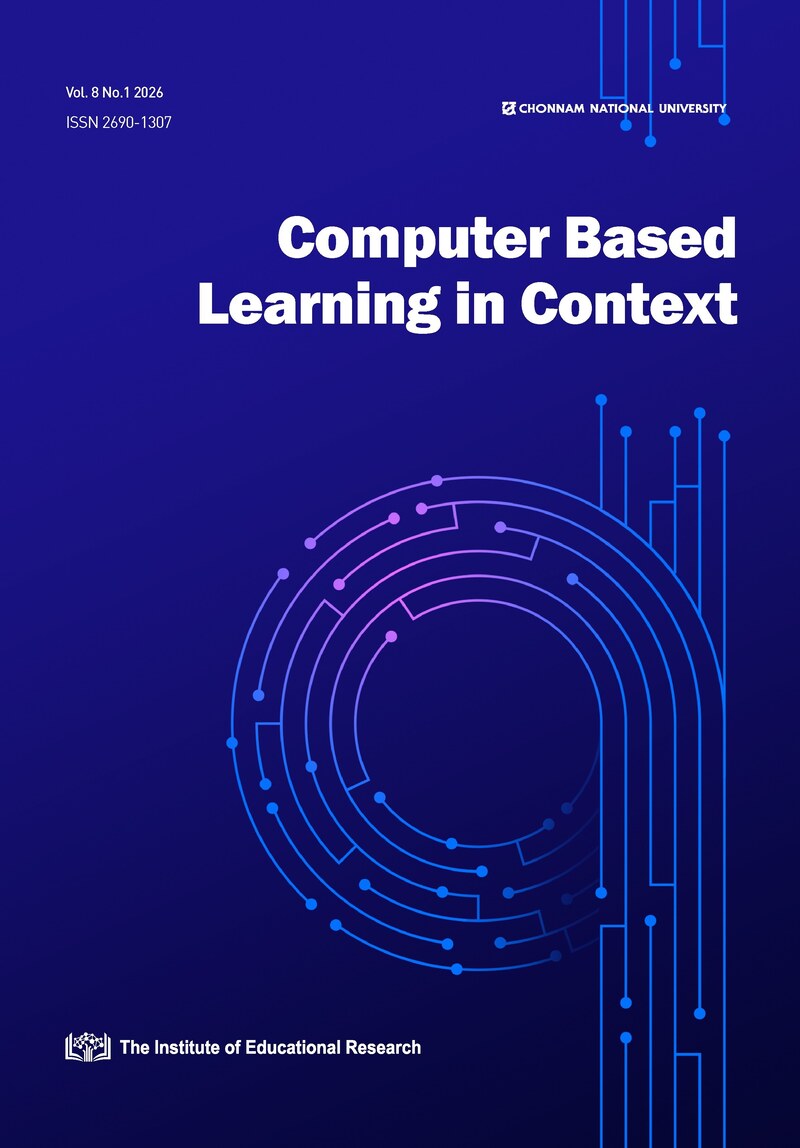
Computer-Based Learning in Context publishes rigorous scientific research on computer-based learning, with particular attention to the ways in which the contexts of learners shape their interactions within and around learning technology, and to the ways in which those differences in interaction shape learning, long term learner outcomes, and educational effectiveness.
CBLC is free for readers and free for authors. There are no subscription fees, no submission fees, and no article processing charges of any kind. Every article is published under an open license and remains permanently available on the web.
ISSN 2690-1307
Journal Information
| Item | Detail |
|---|---|
| Journal title | Computer-Based Learning in Context |
| Abbreviation | CBLC |
| ISSN (online) | 2690-1307 |
| Publisher | The Institute of Educational Research, Chonnam National University, Republic of Korea |
| Publication model | Fully open access, no fees for authors or readers |
| Publication frequency | Biannual (two issues per year) |
| Peer review | Double anonymized peer review, at least three independent reviewers |
| Plagiarism screening | Crossref Similarity Check (powered by iThenticate) |
| Archiving | All published articles are deposited for long-term preservation in the National Library of Korea. |
| License | Creative Commons Attribution-NonCommercial 4.0 International License |
| Copyright holder | The author |
| Established | 2018 |
| First published | 2019 |
| Contact | office@cblcjournal.org |
Open Access
CBLC is a fully open access journal. Every article is freely available to read, download, and share from the moment of publication. There is no embargo period, no registration requirement, and no paywall of any kind. Readers do not pay, and authors do not pay.
Publication Frequency
CBLC publishes two issues per year (June and December) under a continuous publication model. Accepted articles are published online immediately upon completion of production and are subsequently assigned to the current issue.
Copyright & License
This policy is consistent with the definition of open access used by the Budapest Open Access Initiative and with the standard applied by the Directory of Open Access Journals. Users are permitted to read, download, copy, distribute, print, search, and link to the full texts of articles for any lawful noncommercial purpose.